
Indigenous Liberation and Socialism
A failure to recognize class politics within the oppressed can lead to identity adaptation
such as Canada’s Socialist Worker’s newspaper or Spring Magazine (a publication led
by ex- International Socialists) territorial acknowledgement stating support ‘in whatever
forms they take’. At a minimum this is well meaning naivety, supporting traditional tribal
and pan-Indian groups that have clashed with market developers (often with their own
community as well as external actors) over natural resource projects like pipelines. At its
worst, it is a blanket statement that uncritically supports the dominant pro-market
sovereignty aboriginal leaderships who have demonstrated anti-union behaviour against
members of their own community. Class knows no boundaries.A book from Australia’s Socialist Alternative comes at a vital point in Canada’s doublespeak on justice for Indigenous peoples.
“Reconciliation” with Canadian imperialism has received a national statutory holiday while the current national government ignores consent requirements in order to fast-track pipelines and resource megaprojects on First Nations lands. Conservative politicians openly challenge treaty rights if private property is questioned in the courts. Decades-old boil-water advisories are still in existence for dozens of reserves. And the tragedy of missing Indigenous women continues as municipal dumps are excavated for their bodies.
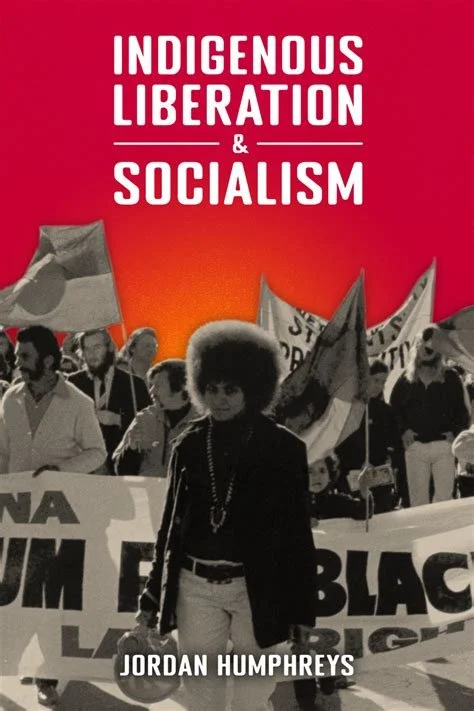
Jordan Humphreys’ Indigenous Liberation and Socialism is a 260-page manual for anyone who wants to know about the relation between indigenous oppression and the class struggle.
Humphreys’ Marxist analysis focuses on three questions: how have indigenous people been oppressed by capitalism; the Australian socialist and workers’ experience in fighting that oppression with indigenous people; and what are the political choices in fighting that oppression today – a renewal of joint socialist struggle or moralist middle class identity politics that divide and demobilize the working majority?
Settler Colonialism or Modern Era?
Humphrey’s first critical argument is that the oppression of Indigenous people has to be historically and materially centred. Settler colonialism was the original capitalist process, the systemic and violent dispossession of Australia’s aboriginal peoples to recast the continent as a space for capitalist development. But who did the dispossessing? This was largely a process driven by the colonial state with large business interests.
The consequence was to marginalize the original population and to create a racially oppressed group of low wage workers.
But Australia, like Canada, is no longer in a settler-colonial era. Today, the vast majority of Aboriginal people are urban — 89% as of the 2021 census — working-class, and still systematically discriminated against in employment, housing, and incarceration. That is, while dispossession still matters, and a few treaties have been negotiated, the primary concern of the vast majority of Indigenous peoples are those of a working-class racialized minority.
This minority, Humphreys notes, have an emergent national consciousness, a product of system challenges since the 1960s, like the Aboriginal Embassy in Canberra. At this point this emergent national consciousness adds a dimension to a working-class consciousness, but not a separatist conclusion.
In other words, Humphreys argues, based on the facts of indigenous oppression in Australia, the original era of land dispossession is not the context to understand the struggle against indigenous oppression in the present era. If we continue to locate our understanding of that oppression in a previous era, we will be trapped in middle-class identity politics emphasizing recognition (land acknowledgements) and reforms promoting the creation of an indigenous elite to facilitate integration with capitalist priorities, while ignoring the new class structure and dynamics among the oppressed – and the market conditions continuing to oppress the indigenous majority, and all workers.
A Tradition of United Struggle Versus Identity Demobilization
Humphreys spends half the book telling the forgotten history of joint struggle between unions, the socialist left (particularly the Communist Party), and indigenous activists. This includes accounts of the Sheep Shearers Movement before 1914, Depression-era strikes, and post-WW2 strikes for racial equality in the workplace.
Humphreys argues Australian workers, whether White or increasingly multiracial, supported indigenous struggles, not out of charity but because a divided working class hurts everyone. If Indigenous workers can be paid less and treated brutally, that threatens the wages and conditions of every worker.
Humphrey’s detailed history of joint struggle politics shows it has been done and has been materially beneficial to the entire working class.
Along with this significant history of joint struggle, there is also a recent history of middle-class identity politics demobilizing the social weight of the working majority to force positive change.
A major barrier to mass mobilization is labour reformism. The Australian Labor Party consistently co-opts radical movements by steering ‘street heat’ into parliamentary committees with few concrete outcomes for Aborigines. The so-called radical labour government of Gough Whitlam in the mid-1970s in particular is scrutinized for this kind of deflective behaviour. Ultimately corporate capitalism is accommodated, rather than land rights or urban reform, even in the case of the defeated 2023 Indigenous Voice referendum to create a parliamentary advisory body.
Humphreys also challenges liberal activist ideas about ‘allyship’, that non-Indigenous supporters can only passively support Indigenous struggles regardless of the politics of Indigenous movements. While our rulers have never found a racist legacy they couldn’t exploit, we live and struggle in a jointly shared exploitative and oppressive modern capitalist, not in the moral guilt of past settler colonialism.
Israel and Settler Colonialism
Humphrey’s work is very useful in making a sharp distinction between Australia and Israel, especially in the aftermath of the Gaza genocide, in addressing settler colonialism.
Israel is an active settler-colonial project, expanding borders and seizing land almost daily in the West Bank, Gaza and anywhere else the IDF can advance. Between the experience of compulsory military service and daily Zionist politics, the vast majority of the population embrace a virulent racism to dispossess the Arab population within ever-increasing borders.
Australia, however, has completed its land seizure. Borders are fixed, military operations are non-existent, and the economy is one of the world’s most advanced capitalist markets.
For Humphreys, Indigenous liberation is not about fighting occupation, but overthrowing the capitalist state which manages the results of settlement, colonization and independence.
A New Indigenous Elite
One critical piece in Humphrey’s study is to show the emergence of a new Indigenous elite through native development corporations in Canada among the Inuit and James Bay Cree and New Zealand’s Maori-Labour state businesses. This has extended to constitutional recognition and state loan programs meant to foster an Indigenous corporate class.
Indigenous people did not disappear in the era of settler colonialism. They recovered and struggled for state recognition in the new market reality. Or, at least, a new middle class sought recognition legally and economically. Through examples from Sydney’s Redfern area, Humphrey shows the same capitalist elite creation process is at work in Australia as the state has worked to incorporate a new urban middle class.
What can we learn in Canada?
Humphrey’s book is critical to socialists posing an alternative class-based struggle against Indigenous oppression.
The era of Canadian settler colonialism is also characterized by state dispossession to facilitate corporate development. Whether we are talking about how French and English governors dispossessed First Nations via the seigneurie system and the Hudson Bay Company, the various British land schemes such as the complete parcelling of Prince Edward Island, to the Canada Land Company and the railway reserve systems in the West, there is a consistent pattern of capitalist dispossession. Holding every immigrant accountable for that dispossession— and their descendants as well—does not fit the facts.
While we know too little about joint worker-Indigenous struggle, there is a history. James Teit, a member of the Socialist Party of Canada led a campaign all the way to London to restore interior British Columbia (BC) land rights before 1914. The Communist Party of Canada built joint union and strike activity in the BC fishing industry. Prairie Métis Communists built the North Saskatchewan indigenous co-operative movement. The modern labour movement also promotes indigenous participation and indigenization measures in collective bargaining.
We need to recover this history of joint struggle. But there are differences here in Canada which make joint socialist work challenging.
While the majority of Indigenous people in Canada are urban, 40% of “status Indians” are still rural. Urban Natives are often first generation migrants with powerful ties back to their reserves. There has been a slower economic and geographical integration with non-Indigenous Canada than in Australia.
Despite the viral Idle No More youth movement in 2012, the politics of the “Status Indian” leadership, as expressed through the Assembly of First Nations (AFN), continues to dominate the struggle for Indigenous rights. The AFN is a leading proponent of modern elite creation through modern treaty making and revision, and of indigenous businesses with significant government loan and expertise support programs. Métis and Inuit organizations imitate this elite market orientation.
This is not to lessen the record of these groups in advocating for civil rights, political autonomy such as the Nisga’a in BC and welfare measures. But the context is market integration. And that context can often produce anti-union sentiment as a limitation on Indigenous self-determination. The struggle to unionize First Nations post secondary institutions in Regina and Merritt, BC are sobering examples.
A failure to recognize class politics within the oppressed can lead to identity adaptation like the territorial acknowledgement published by Canada’s International Socialists (IS) and Spring Solidarity Network (led by ex-members of the IS). They affirm support for such statements ‘in whatever forms they take’. At best, this is well-meaning naiveté, supporting traditional tribal and “pan-Indian” groups that have clashed with capitalists, often within their own communities as well as external actors, over natural resource projects like pipelines. At worst, such an acknowledgement is a blanket statement that uncritically supports the dominant pro-market sovereignty pf Indigenous leaderships who have demonstrated anti-union behaviour against members of their own community. Class knows no boundaries.
When Canadian Marxists came to understand Canada’s other national question, the oppression of French Canadians, there was a common understanding that French Canadians, through the province of Quebec, have an unconditional right to self-determination. However, this recognition was not uncritical. We recognized the class contradictions of the Parti Quebecois and argued for working-class unity wherever possible.
But these challenges are not insurmountable. First Nations University and the Nicola Valley Institute of Technology are unionized. The International Socialists successfully fought off the Aryan Nations in Saskatchewan in the 1980s with Indigenous University youth organizations.
To build on a bigger scale, however, we need Humphrey’s analysis. We are no longer in the era of settler colonialism, even as we deal with its legacy, but in a shared modern capitalist nation state; there is a history and possibility of united struggle on a working class basis; and we must not adapt to the abstract middle class moralism of identity politics. Down that road lies a new inequality among the oppressed and a fragmented struggle against the one system exploiting and oppressing all of us.
Jordan Humphreys, Indigenous Liberation and Socialism, Melbourne: Red Flag Books, 2023. The book can be ordered at redflag.org.au